Author Stella Wang

Saro-Wiwa K. (1994). Sozaboy: a novel in rotten English. White Plains, N.Y., Longman. Find the book at worldcat.org/isbn/0582236991

Smith, Z. (2008). Speaking in tongues. The New York Review of Books (2009, February 26). Find the article here.
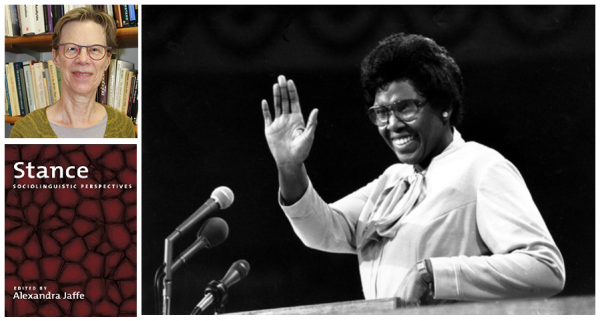
Johnstone, Barbara. (2009). Stance, style, and the linguistic individual. In A. M. Jaffe (Ed.), Stance: Sociolinguistic Perspectives (pp. 20-52). New York: Oxford University Press. Find the book at worldcat.org/isbn/9780195331646

NCTE (National Council of Teachers of English). (1998, 2016). CCCC Statement on Ebonics. Check out the resolution here

NCTE (National Council of Teachers of English). (1974). Resolution on the Students’ Right to Their Own Language. Check out the resolution at here.

Villanueva, V. (2013). Subversive complicity and basic writing across the curriculum. Journal of Basic Writing 32(1): 97-110. Find the article here.

Smitherman, G. (1977). Talkin and testifyin: The language of Black America. Wayne State University Press. Find the book at worldcat.org/isbn/0814318053 An excerpt: The most distinctive differences in the structure of Black Dialect are patterns using be (sometimes written and pronounced… Continue Reading →

Williams-Farrier, B.J. (2017). “Talkin’bout Good & Bad” Pedagogies: Code Switching vs. Comparative Rhetorical Approaches. College Composition and Communication 69(2), 230-259. Find the article here.

Lyons, S. R. (2010). There’s no translation for it: The rhetorical sovereignty of indigenous languages. In B. Horner, M-Z Lu, and P. K. Matsuda (Eds.), Cross-language relations in composition (pp. 127-141). Carbondale, IL: Southern Illinois University Press. Find the book at worldcat.org/isbn/0809329824

